Vaginal suppositories
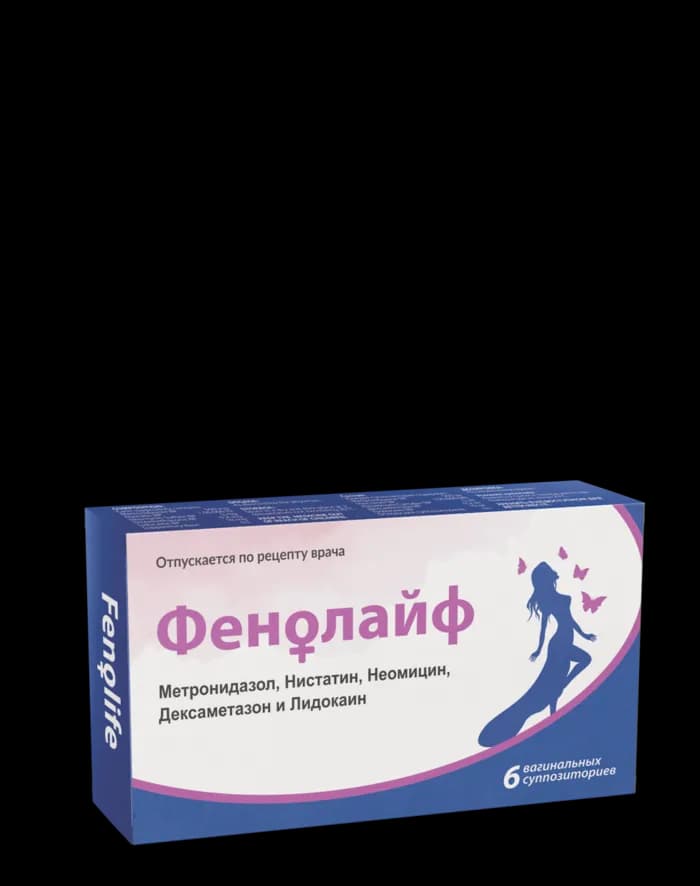
Fenolife
- Local treatment of vulvitis, vaginitis and cervical infections
- Antifungal
- Trichomonacidal
Medicine
Properties and indications
- 01
Local treatment of vulvitis, vaginitis and cervical infections
- 02
Antifungal
- 03
Trichomonacidal
- 04
Antibacterial and anti-inflammatory local action

Brief description
6 vaginal suppositories
Metronidazole, Nystatin, Neomycin, Dexamethasone and Lidocaine
Pharmacological properties
Pharmacological properties:
Antibacterial spectrum of action
Metronidazole: trichomonas vaginalis
Anaerobic gram-negative bacilli, including: Bacteroides fragilis, Fusobacterium spp
Anaerobic gram-positive bacilli: Clostridium rium
Gram-positive cocci, including: Peptococcus niger, Peptostreptococcus spp
Nystatin: Candida albicans non-albicans
Neomycin: Escherichia coli Klebsiella spp-Enterobacter
Pharmacodynamics:
Metronidazole
An antibacterial, antiprotozoal agent; active against most obligate bacteria and protozoa by undergoing intracellular chemical reduction through mechanisms unique to anaerobic metabolism.
Reduced metronidazole, which is cytotoxic but has a short half-life, interacts with DNA to cause disruption of its helical structure and strand breakage, resulting in inhibition of nucleic acid synthesis and cell death.
Metronidazole has a bactericidal action. Its use does not alter the natural symbiotic flora.
Nystatin Sulfate
An antifungal agent with fungistatic and fungicidal action. It binds to sterols in the cell membrane, which acts as a selective barrier, leading to the loss of essential cell constituents.
Neomycin Sulfate
An antibiotic with a local antiseptic action.
Lidocaine
An anesthetic for the vaginal mucosa.
Dexamethasone
Topical application of dexamethasone has anti-inflammatory, antipruritic and vasoconstrictive effects.
Its mechanism of action is not fully known.
Available data suggest a correlation between their vasoconstrictive action and therapeutic efficacy in humans.
Pharmacokinetics:
When metronidazole is administered vaginally, systemic absorption is approximately 20% of the dose.
Neomycin Sulfate and Nystatin Sulfate:
Not absorbed through intact skin or mucous membranes. However, neomycin may be absorbed via this route of administration if there are large lesions, burns or granulation areas; thus, the possibility of systemic effects of neomycin Sulfate cannot be excluded.
Dexamethasone:
Although the amount of corticosteroid is low, a systemic effect in sensitive patients cannot be excluded.
After absorption, it has the same pharmacokinetics as systemically administered corticosteroids. It binds to plasma proteins and is metabolized primarily by the liver and then excreted by the kidneys.
Some topical corticosteroids and their metabolites are also excreted in the bile.
How to use
Adults:
Insert 1 or 2 suppositories into the vagina, once a day, for 6 to 12 days.
If the treatment needs to be repeated, an interval of 4-6 weeks is recommended.
Composition
Each suppository contains:
- Metronidazole BP – 500 mg
- Nystatin BP – 100,000 IU
- Neomycin Sulfate BP – 5 mg
- Dexamethasone BP – 0.2 mg
- Lidocaine BP – 10 mg
- Suppository base – q.s.
Catalogue