Supplement for parenteral nutrition
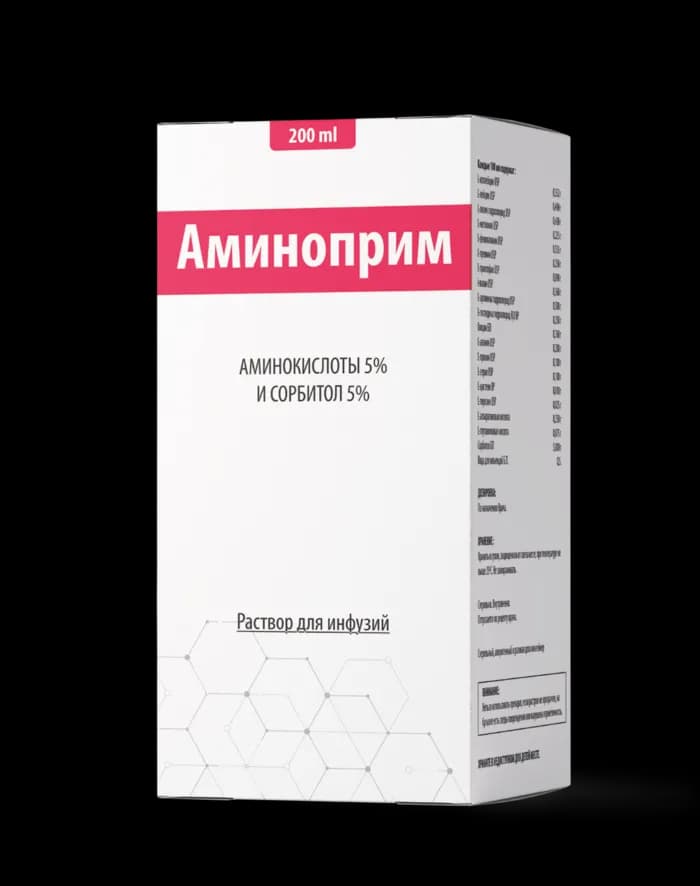
Aminoprim
- Acute and chronic renal failure during hemofiltration, peritoneal dialysis and hemodialysis
- To compensate for amino acid losses during and after dialysis or hemofiltration
- Renal failure after polytrauma, extensive surgical intervention and sepsis
Medicine
Properties and indications
- 01
Acute and chronic renal failure during hemofiltration, peritoneal dialysis and hemodialysis
- 02
To compensate for amino acid losses during and after dialysis or hemofiltration
- 03
Renal failure after polytrauma, extensive surgical intervention and sepsis
- 04
Supplement to a low-protein diet for patients with chronic renal failure
- 05
Support during periods when feeding via the GI tract is impossible
- 06
Support of protein metabolism
- 07
Rapid and complete assimilation
- 08
Comprehensive effect

Brief description
Solution for infusion, 200 / 500 ml
Amino Acids 5% And Sorbitol 5%
A clear, colorless solution containing a well-balanced mixture of pure crystalline essential, semi-essential and non-essential amino acids in optimal concentrations for protein synthesis
AMINOPRIM is highly valued as a supplement for parenteral nutrition
Support during periods when feeding via the GI tract is impossible
Amino acids are the building blocks of proteins
Controlled and precise dosing
Support of protein metabolism
Rapid and complete assimilation
Comprehensive effect
Contraindications
Disorders of amino acid metabolism.
Hepatic coma.
Severe renal impairment, hypernatremia and hyperkalemia.
Overhydration.
Metabolic acidosis.
How to use
AMINOPRIM is available as a sterile, non-pyrogenic single-dose container that can be administered through peripheral veins or via a central venous route using a non-pyrogenic intravenous administration set with aseptic technique.
DOSAGE:
Recommended daily dose: up to 0.5 g of amino acids / kg of body weight per day for patients with acute and chronic renal failure not receiving dialysis.
Up to 1 g of amino acids / kg of body weight / day in a patient receiving treatment with hemodialysis, hemofiltration or peritoneal dialysis.
The dosage should be adjusted according to the amino acid requirements depending on the age, body weight and condition of the patients.
A sufficient amount of calories should be administered simultaneously, orally or parenterally.
INFUSION RATE:
The infusion rate of AMINOPRIM should not exceed 40 drops per minute.
Composition
Each 100 ml contains:
- L-isoleucine USP – 0.352 g
- L-leucine USP – 0.490 g
- L-lysine hydrochloride USP – 0.430 g
- L-methionine USP – 0.225 g
- L-phenylalanine USP – 0.533 g
- L-threonine USP – 0.250 g
- L-tryptophan USP – 0.090 g
- L-valine USP – 0.360 g
- L-arginine hydrochloride USP – 0.500 g
- L-histidine hydrochloride H₂O BP – 0.250 g
- Glycine BP – 0.760 g
- L-alanine USP – 0.200 g
- L-proline USP – 0.100 g
- L-serine USP – 0.100 g
- L-cysteine BP – 0.010 g
- L-tyrosine USP – 0.025 g
- L-aspartic acid – 0.250 g
- L-glutamic acid – 0.075 g
- Sorbitol BP – 5.000 g
- Water for injection B.P. – Q.S.
Electrolytes (mmol/l):
- Na+ – 37.000 (mmol/l)
- Cl- – 59.000 (mmol/l)
- Total amino acids – 50 g/l
- Total nitrogen content – 7.25 g/l
- Energy content – 400 kcal/l
- Osmolarity – 800 mOsmol/l
Side effects
Occasionally, chest discomfort and palpitations are possible.
If the recommended infusion rate is exceeded, nausea, vomiting, chills and a feeling of heat are possible.
Additional information
Packaging:
Available in glass bottles of 200 and 500 ml.
Storage conditions:
Store in a cool place, protected from light. Do not freeze.
Precautions:
If administered too quickly, signs of intolerance and increased renal losses of amino acids are possible.
During therapy, fluid balance, serum electrolytes, blood sugar and acid-base balance should be monitored.
The solution is not suitable for long-term parenteral use, as it does not contain a sufficient amount of non-essential amino acids.
During long-term therapy, fat should be included in the diet to avoid a deficiency of essential fatty acids.
Manufacturer:
Shree Krishnakeshav Laboratories Ltd., Ahmedabad, Gujarat, India. Manufactured for AKIS Pharma, Tbilisi, Georgia.
Catalogue